As enterprises accelerate their shift toward hybrid cloud, one requirement has become non‑negotiable: a storage platform that delivers enterprise‑grade consistency, performance, and resilience—no matter where workloads run.
Red Hat OpenShift has established itself as the leading enterprise Kubernetes platform for deploying modern, containerized, and stateful applications. But as organizations run more databases, analytics engines, and event‑streaming workloads on OpenShift, the choice of persistent storage becomes critical.
While Google Cloud Hyperdisk is a strong native option, many businesses quickly run into its architectural limitations when running mission-critical or hybrid cloud workloads.
This is where Hitachi Vantara’s VSP One SDS Block on Google Cloud Platform (GCP) stands out—bringing enterprise-class capabilities traditionally found in on‑prem storage arrays directly into the cloud.
In this blog, we explore how VSP One SDS Block enhances OpenShift deployments on GCP and why it goes far beyond the capabilities of Hyperdisk.
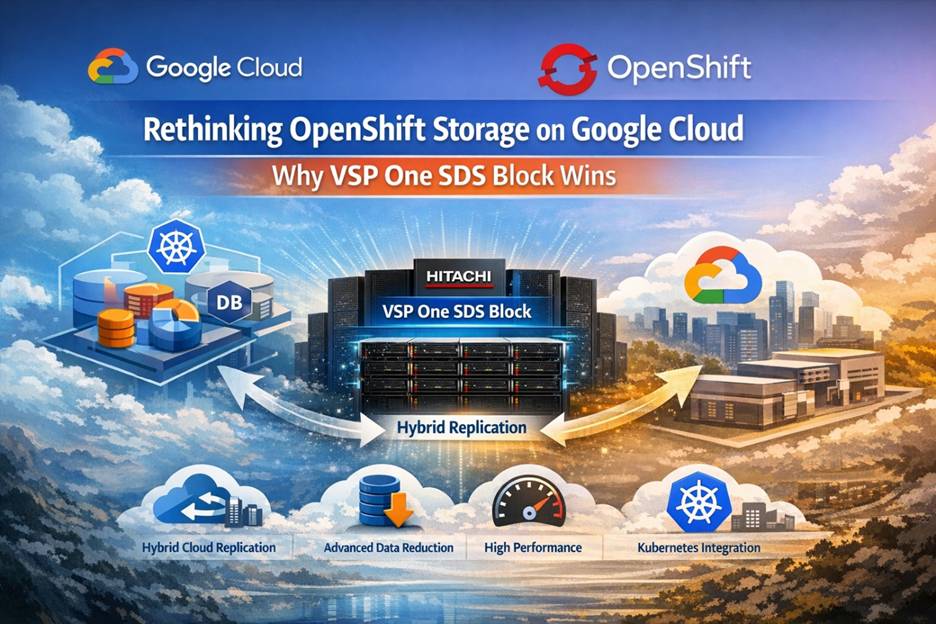
Bringing Enterprise Storage to Google Cloud: VSP One SDS Block
VSP One SDS Block is a software-defined, scale-out, shared-nothing block storage platform that runs natively in AWS, Azure, and GCP. It brings the reliability and data services of Hitachi’s on‑prem Virtual Storage Platform (VSP) into public cloud environments.
Here are some of the Key Capabilities of SDS Block on GCP
- Predictable performance under heavy, mixed workloads
- Inline data reduction (compression + fixed pattern elimination)
- Replication across on‑prem ↔ GCP
- Multi‑AZ resilience
- Thin provisioning for cost efficiency
- Kubernetes CSI‑native integration
- Unified hybrid cloud storage management
These features make SDS Block an enterprise‑grade alternative to Hyperdisk—especially for organizations running production databases and stateful applications.
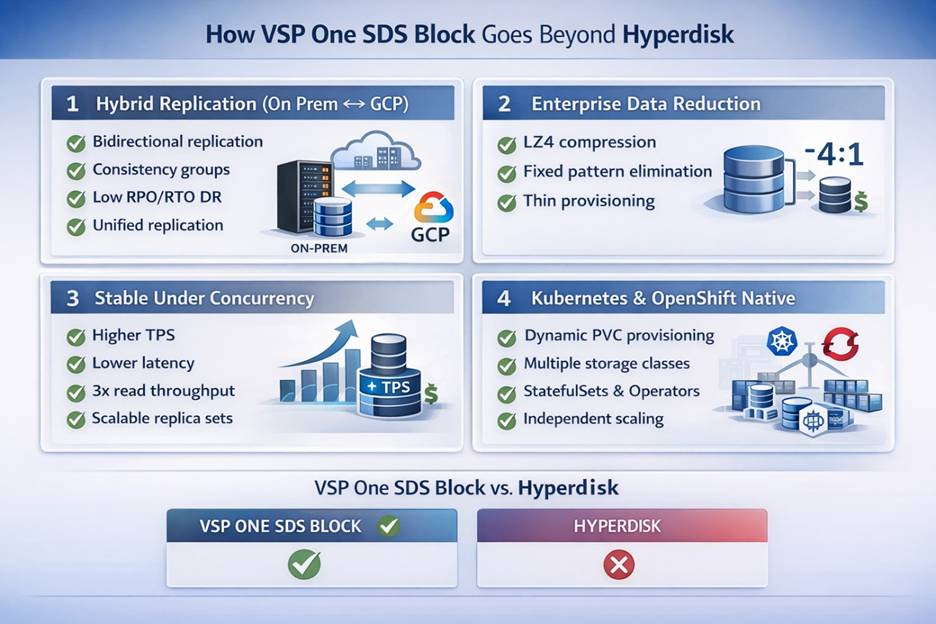
Real‑World Performance Results
PostgreSQL (Pgbench)
On VSP One SDS Block (GCP) vs Hyperdisk Balanced:
- 10–20% higher TPS
- ~4:1 data reduction
- More consistent latency
MongoDB on OpenShift (YCSB)
Although the MongoDB tests were on AWS, the architectural behavior applies equally to GCP.
Results show:
- 2×–3× better read throughput
- 10×–15× lower write latency under heavy load
- Superior stability beyond 32–64 threads
This demonstrates SDS Block’s advantage in real‑world, high‑concurrency scenarios.
Why Storage Matters for OpenShift Stateful Workloads
OpenShift’s value as a platform for cloud-native applications is tied to its ability to support:
- Databases (PostgreSQL, MongoDB, Oracle)
- Messaging systems (Kafka, Pulsar)
- Analytics platforms
- AI/ML pipelines
- Enterprise middleware
All these demands:
- Low, predictable latency
- High throughput under concurrency
- Cross-zone high availability
- Dynamic scaling
- Efficient capacity utilization
Kubernetes alone does not deliver advanced storage services—these must come from the underlying block storage layer.
Best Practices for Deploying SDS Block with OpenShift on GCP
Below are the best practices and recommendations to ensure your VSP One SDS Block environment in GCP performs to the best of its abilities to achieve your business goals.
1. Deploy SDS Block on Dedicated GCP Instances
This ensures fault isolation and linear scaling.
2. Use Multiple Storage Classes
Suggested classes:
- High‑performance (databases)
- Balanced (general workloads)
- Capacity‑optimized (analytics)
3. Enable Compression for All Supported Workloads
Especially: PostgreSQL, MongoDB, Kafka, Elasticsearch.
4. Use SDS Block Replication for DR
Avoid Hyperdisk‑only DR since it cannot replicate outside GCP.
5. Leverage Telemetry for Optimization
Monitor:
- Data reduction ratios
- Volume-level latency
- PVC growth trends
When Should You Choose SDS Block on GCP?
SDS Block is the best option when your workload requires:
✔ Enterprise databases (PostgreSQL, MySQL, Oracle)
Predictable low latency + data reduction + hybrid DR.
✔ Event streaming & messaging (Kafka, Pulsar)
Stable write performance (no collapse under concurrency).
✔ Analytics / read-heavy workloads (MongoDB)
Up to 3× higher read throughput at scale.
✔ Hybrid cloud mobility & DR
Cloud-native disks create silos; SDS Block keeps environments unified.
Conclusion
VSP One SDS Block on GCP is more than a cloud storage option—it is a full enterprise storage platform delivered as software in the cloud.
Compared to Google Cloud Hyperdisk, SDS Block delivers:
- Stronger performance under real-world concurrency
- Better cost efficiency through advanced data reduction
- Unified hybrid cloud data management
- Enterprise-grade resiliency and replication
- Consistent storage behavior across on‑prem and cloud
For organizations running mission‑critical, stateful applications on Red Hat OpenShift, SDS Block removes the traditional trade-offs between cloud agility and enterprise reliability.
It brings the power of Hitachi’s enterprise storage to Google Cloud—unlocking predictable, scalable, and cost‑optimized operations for your Kubernetes workloads.
For more details, refer to the following best practices guide: Deploying Red Hat OpenShift on VSP One SDS Block on Google Cloud Platform
Feel free to reach out to me or the Hitachi Vantara Solution Engineering and Architecture team for any questions you may have.
#VSPOneSoftwareDefinedStorage