Announcing Support of Proxmox VE 9.1 with Hitachi VSP One Storage Platforms
Enabling a supported option for pairing open virtualization with trusted enterprise storage
The decisions that customers need to make to plan, implement, and control their virtualization infrastructure are changing. There is constant pressure for more flexibility, more cost control, and more freedom to control how infrastructure evolves. Organizations are actively looking for robust, cost-effective, and open-source alternatives to regain control of infrastructure and budgets, but without sacrificing enterprise reliability or being forced into new HCI vendor silos.
Above all, it’s about choice.
Enter Proxmox VE
Proxmox VE is rapidly becoming an increasingly attractive option to address the rising costs and licensing complexities associated with traditional vendors like VMware. The open platform stack combines virtual machines, containers, clustering, high availability, and live migration into a flexible and practical solution for organizations evaluating alternatives to traditional virtualization stacks. Using Proxmox provides the agility and cost-efficiency of a leading open-source virtualization platform, without being locked into proprietary solutions with rigid and expensive ecosystems.
Proxmox offers a feature-rich, cost-effective virtualization platform that is accessible to organizations of all sizes. SMBs and mid-range customers gain access to the same data resiliency, performance, and scalability once reserved for large enterprises. This combination allows them to:
- Maximize IT Budgets: Avoid expensive hypervisor licensing fees and invest in infrastructure that delivers long-term value and scales with their business.
- Simplify Operations: Leverage a proven, reliable foundation that reduces management overhead and allows smaller teams to support mission-critical workloads with confidence.
- Future-Proof Their Infrastructure: Build a flexible and open environment that can adapt to changing business needs without being locked into a single vendor's roadmap.
The Storage Reality: What Doesn’t Change
At the same time, while the hypervisor layer is evolving, customer expectations for storage are not. Performance, resiliency, scalability, and operational consistency remain non-negotiable, especially for production workloads. Those looking to explore alternative virtualization paths need a highly compelling, proven solution backed by the storage foundation they already trust. Robust storage remains a universal requirement, affecting both enterprise and small and mid-range businesses (SMBs), who often face unique challenges. They require enterprise-level capabilities to compete and grow but often operate with tighter budgets and smaller IT teams. And ultimately, the underlying storage architecture is the key determinant whether an environment is suitable for production workloads.
Finding the right storage option for Proxmox can be challenging. Local-only configurations provide a simple solution, but at the cost of resiliency and mobility, which potentially creates operational challenges. Commodity shared storage options can introduce lower cost options for scalability; however, this may come without enterprise class support or mature data services. HCI based solutions are also available, but those can also increase the complexity, tying scaling of compute and storage together.
That need for modern virtualization choice with uncompromising storage requirements is exactly why Hitachi Vantara is stepping up to bridge the gap between open-source agility and enterprise-class storage.
Why Proxmox with Hitachi VSP One?
Pairing Proxmox with Hitachi Vantara's proven, mission-critical storage platforms is critical for removing the guesswork and risk from deploying open-source virtualization for business-critical applications. This empowers customers to escape vendor lock-in and build a flexible, future-proof infrastructure without sacrificing the enterprise-class features they depend on.
In contrast to the other options, integrating VSP One with Proxmox can give customers a stronger enterprise foundation: validated Fibre Channel and iSCSI connectivity, shared storage for cluster-wide operations, multipath resiliency, and the ability to scale compute and storage independently.
This is where the synergy between Proxmox and Hitachi VSP One truly shines. This is a powerful pairing that democratizes enterprise-class IT, enabling organizations of all sizes to build a resilient and high-performance infrastructure that powers their growth.
Announcing Proxmox VE 9.1 Interoperability with Hitachi VSP Storage
Hitachi Vantara now supports interoperability between Proxmox VE 9.1 and Hitachi Vantara VSP storage platforms, including validated Fibre Channel and iSCSI connectivity options.
This milestone gives customers a supported way to pair a growing open virtualization platform with enterprise-grade block storage, providing a new, credible foundation for modern virtualized infrastructure.
Combining Proxmox VE with Hitachi Vantara VSP and VSP One storage enables much-needed flexibility - bringing together open virtualization and trusted enterprise storage in a way that supports real-world production environments.
- Modernizing beyond proprietary virtualization: Organizations evaluating alternatives to traditional hypervisors can adopt Proxmox while continuing to rely on proven SAN-based storage for production workloads.
- Running mission-critical workloads on open platforms: With Fibre Channel performance and resilient shared storage, customers can confidently support databases and tier-1 applications in Proxmox environments.
- Building scalable private cloud infrastructure: Teams can use shared VSP storage with Proxmox clusters to enable workload mobility, simplify scaling, and standardize operations across environments
Details on what was tested can be found in the Product Compatibility Guide. In addition, we have also published a Reference Architecture guide that walks through key concepts of the integration with Proxmox.
Inside the Reference Architecture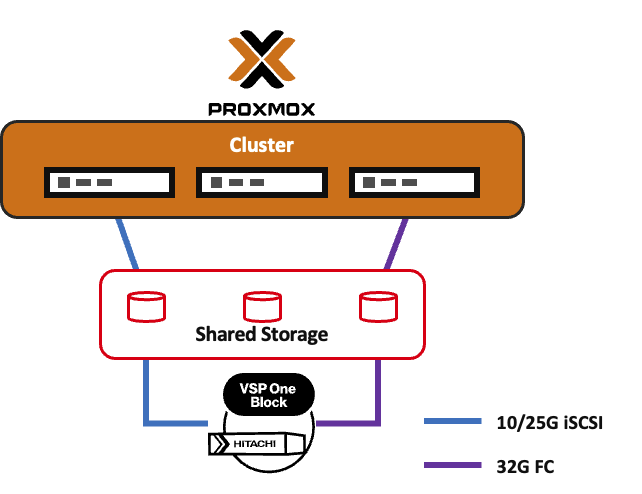
To help customers move from evaluation to deployment with confidence, this style of deployment is backed by a validated reference architecture that describes a real-world, production-representative configuration for integrating Hitachi VSP One Block shared storage with Proxmox VE. The reference architecture is designed to demonstrate production-relevant workflows in a configuration that reflects how customers would deploy and operate Proxmox VE with enterprise shared storage.
Interoperability
Our initial interoperability support covers multiple Hitachi VSP storage platforms, giving customers flexibility to match their Proxmox deployment to the storage infrastructure they already have in place or plan to deploy:
• VSP One Block (B20 series) via iSCSI - Ethernet-based shared storage deployments (B24, B26, B28)
• VSP One Block (B20 series) via Fibre Channel - high-performance FC deployments (B24, B26, B28)
• VSP 5000 series via Fibre Channel - high-end VSP infrastructure (5100/5200/5500/5600)
• E Series via Fibre Channel - Hitachi E Series storage (E590, E790, E990, E1090)
This breadth of array support means customers are not limited to a single storage platform. Whether they are deploying new VSP One Block systems or leveraging existing VSP 5000 or E Series infrastructure, they have a supported path to integrate with Proxmox VE.
Design Principles
The architecture is built around a set of core design principles that guide how storage is integrated with Proxmox VE:
- Consistent shared-disk access: Every Proxmox VE node that may host, migrate, restart, or recover a virtual machine must have access to the same underlying VM disks. This requirement drives the storage network design, host multipath configuration, and storage object layout.
- Compute and storage separation: VM disks are placed on external Hitachi shared storage rather than local node storage. This separates compute resources from persistent data, enabling workload mobility, simplifying node maintenance, strengthening recovery flexibility, and establishing a more resilient operational foundation.
- Multiple protocol options: Coverage for both iSCSI-backed and Fibre Channel-backed storage configurations allows customers to align specific workloads with the connectivity model that best fits their requirements.
- Multipath resiliency below the virtualization layer: Redundant storage paths are managed through Linux multipath on each Proxmox VE host, providing stable device access to Hitachi-backed volumes before they are consumed by Proxmox VE. This applies to both shared LVM-backed storage and direct-attached dedicated data disks.
- Operational repeatability: The architecture follows repeatable, documented workflows for every validated operation, providing a practical blueprint that can be applied consistently across deployments.
Supported Topologies
Our interoperability support is built around the storage architectures customers already rely on today. This gives customers the flexibility to align specific workloads with the connectivity model that best fits their performance and operational requirements
|
|
Fibre Channel
• High-performance SAN connectivity for latency-sensitive and mission-critical workloads
• Validated with 32G Fibre Channel switching infrastructure
• Redundant fabric design with Linux multipath for host-side path resiliency
|
|
|
iSCSI
• Flexible Ethernet-based block storage deployments using existing IP network infrastructure
• Validated with 10/25G Ethernet connectivity
• Redundant network paths with Linux multipath for host-side path resiliency
|
Storage Resource Models
Proxmox provides several options for storage of virtual machine and container data. The primary options for Fibre Channel and iSCSI-based connectivity, LVM and direct-mapped LUNs, enable customers to combine the flexibility of Proxmox with the reliability, scalability, and operational discipline of enterprise SAN storage, all without forcing a shift to new or unfamiliar infrastructure models.
Shared LVM-Backed Proxmox VE Storage
Shared LVM-backed storage is the most straightforward storage model for Fibre Channel and iSCSI connected storage in Proxmox.
|
How it works
Hitachi VSP One Block shared volumes are presented to all eligible Proxmox VE nodes and claimed through Linux multipath. The resulting multipath devices are used as LVM physical volumes and organized into LVM volume groups. Proxmox VE consumes these volume groups as shared storage objects and creates virtual machine disks as LVM logical volumes.
|
|
This model keeps VM disks independent of local host storage and allows any eligible Proxmox VE node to access the same VM disk layout for migration, backup, restore, snapshot rollback, and restart-based HA recovery.
|
Why it matters
Shared LVM-backed storage aligns closely with Proxmox VE recommended practices for shared block FC or iSCSI backed storage, in the absence of a dedicated storage plugin. It provides the most complete integration with Proxmox VE cluster-wide operations, including live migration, backup, snapshot, clone, and HA workflows. The approach also allows flexible capacity planning: a deployment may use a larger shared storage object for a group of virtual machines or use multiple shared storage objects where workload separation or operational control is required.
|
Direct 1:1 Hitachi LUN-to-VM Data Disk Mapping
An alternate approach to storage management in Proxmox is direct 1:1 Hitachi LUN-to-VM data disk mapping.
|
How it works
In this model, dedicated Hitachi VSP One Block volumes are presented to the participating Proxmox VE nodes, claimed through Linux multipath, and attached directly to a selected virtual machine as raw SCSI disks.
|
|
Unlike the shared LVM-backed model, a directly attached dedicated data disk is not initialized as an LVM physical volume, is not added to an LVM volume group, and is not consumed as a Proxmox VE-managed LVM logical volume on the host. Instead, the stable multipath device path is attached directly to the VM. The guest operating system detects the attached disk as an independent data disk and can format, mount, and use it for filesystem or application data. The dedicated volumes must be presented through Linux multipath to the participating Proxmox VE nodes and configured as shared virtual machine disk devices when live migration, manual restart, or restart-based HA recovery is required.
|
Why it matters
This model provides explicit alignment between a selected virtual machine data disk and its backing Hitachi storage volume. It is suitable for workloads where a dedicated storage-volume relationship is required for operational identification, isolation, or application data placement. It also enables clearer troubleshooting and direct performance alignment between a VM data disk and its underlying storage resource.
While shared LVM-backed configurations can offer flexibility through pooled storage, that same flexibility can potentially introduce sources of workload contention. Direct mapping provides a more isolated and predictable design, ensuring consistent performance with clear workload boundaries. This enables a simpler operational model that can scale predictably as environments evolve, allowing administrators to extend capacity and performance in a controlled, workload-aligned manner.
|
What This Means for Customers
At its core, this announcement is about enabling practical infrastructure choice.
Customers are not all modernizing in the same way, and this ensures they don’t have to. Some are optimizing existing platforms. Others are actively exploring new virtualization paths. What matters most is having the flexibility to make those decisions without sacrificing the reliability of the underlying infrastructure.
This unlocks the potential to:
• Evaluate or deploy Proxmox VE without compromising on enterprise storage
• Maintain SAN-based architectures that support production workloads
• Improve workload mobility and operational flexibility through shared storage
• Simplify maintenance and recovery workflows compared to local-only storage models
• Build a more resilient and scalable virtualization foundation
What’s Next?
This is just the beginning…more updates to come. Stay tuned to this space for more developments!
Important Links