Introduction
As enterprises accelerate their hybrid cloud adoption, they seek storage solutions that deliver the performance, resilience, and efficiency of enterprise-grade systems while retaining the agility and scalability of the public cloud. Hitachi VSP One SDS Block on AWS is the software-defined storage (SDS) solution that bridges this gap by delivering Hitachi’s trusted enterprise storage technologies to the AWS cloud.
Modern applications require PostgreSQL to deliver low latency, high throughput, and predictable performance to support microservices and real-time workloads. It must scale efficiently with growing data volumes while ensuring strong durability, high availability, and rapid failover. In cloud-native and Kubernetes environments, PostgreSQL needs seamless integration with orchestration platforms for dynamic provisioning, resilience, and automation. Additionally, storage efficiency, security, and cost optimization are essential to sustain reliable and enterprise-grade database operations.
This blog explores the use of VSP One SDS Block on AWS for a PostgreSQL database that provides customers with the performance and reliability they can depend on as a superior storage option compared to Amazon EBS for PostgreSQL databases.
Benefits of using VSP One SDS Block on AWS
Here are a few benefits of using VSP One SDS Block for a PostgreSQL database:
• Enterprise-Grade Data Services in the Cloud: Bring Hitachi’s proven on-premises enterprise storage capabilities, such as replication, encryption, and QoS — natively into AWS environments for mission-critical workloads.
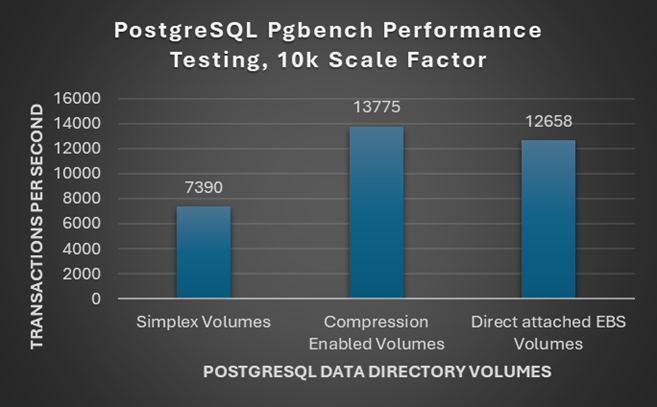
• Superior Performance Consistency: Deliver predictable block performance through intelligent caching and workload-aware optimization — even under mixed or high I/O loads — unlike Amazon EBS volumes, which can experience performance variability under shared tenancy. During this evaluation, it was observed that compression-enabled VSP One SDS Block volumes delivered better performance compared to directly attached EBS volumes.
• Advanced Data Efficiency: Leverage built-in compression and thin provisioning to significantly reduce storage footprint and ongoing costs, enabling better $/IOPS and $/GB economics compared to standard EBS volumes.
• Flexible Scalability and Provisioning: Scale capacity and performance independently and dynamically to meet changing workload demands, avoiding the need for rigid volume types or manual size adjustments common in Amazon EBS environments.
• Integrated Data Protection and Resilience: Built-in replication and multi-AZ support ensure business continuity and disaster recovery across regions or availability zones, without relying solely on external backup solutions.
• Optimized Total Cost of Ownership: Reduce total cost through data efficiency, performance tiering, and better resource utilization — achieving a lower cost per transaction and per GB throughout over the data lifecycle.
• Security and Compliance Alignment: Benefit from Hitachi’s enterprise-grade encryption, access controls, and compliance certifications layered on top of AWS’s secure infrastructure, ensuring adherence to stringent data governance requirements.
• Seamless Integration with AWS Ecosystem: Deploy and operate directly within AWS while maintaining compatibility with AWS services (such as EC2), giving customers the flexibility to modernize storage without re-architecting workloads.
Game changer
The data reduction feature in VSP One SDS is the key characteristic that optimizes storage utilization by intelligently minimizing the physical space consumed by data. It combines multiple space-saving techniques such as data compression, and fixed pattern elimination to deliver higher storage efficiency and lower total cost of ownership in cloud deployments.
Key Components of the data reduction function:
• Data Compression compresses data before writing it to the storage media, reducing capacity requirements without impacting application performance. The process is transparent to applications and reversible during reads.
• Fixed Pattern Elimination identifies and eliminates predictable, repeating data patterns that provide no informational value, such as sequences of zeros, FFs. Essentially, it’s a pre-filtering stage that removes or skips writing blocks filled with fixed, non-random content before they are processed by heavier compression algorithms. This reduces unnecessary CPU and I/O cycles, improving the overall data reduction ratio and performance of PostgreSQL database as well as many others.
• Thin Provisioning allocates storage space dynamically on demand rather than reserving it upfront, ensuring optimal use of physical capacity while maintaining logical volume flexibility.
Infrastructure Overview
Below are the key components deployed in PostgreSQL architecture during our validation:
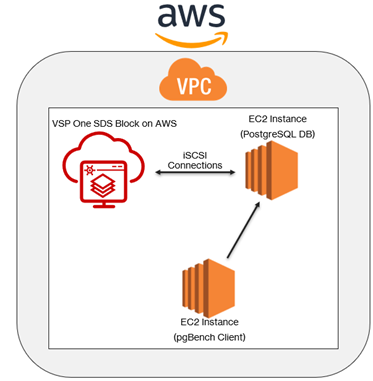
• Software-Defined Storage Cluster: During SDS Cloud testing, storage is deployed through a cluster of EC2 instances using Amazon EBS volumes, with the database server accessing the storage through the iSCSI protocol.
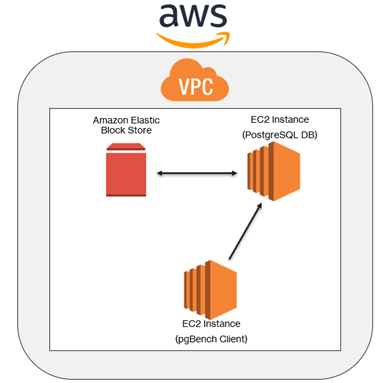
• Database Client: The load-generation client running pgBench operates on a separate server to avoid any contention for computing resources. Performance results are collected directly from this server.
• Database Server: The database component resides on a dedicated Linux server running PostgreSQL, deployed with a standard configuration.
Below figures illustrate the logical diagrams of the environment used for this evaluation. In the configuration using VSP One SDS Block on AWS, storage resources are supplied over iSCSI protocol. In the platform-native storage tests, resources (EBS) are configured directly on the database server.
Test Environment
For comparison purposes, the following three test environments were set up for our validation:
• Using VSP One SDS Cloud: Simplex volumes were mapped to PostgreSQL database, and tests were run.
• Using VSP One SDS Cloud: Compression-enabled volumes were mapped to the PostgreSQL database, and tests were run.
• AWS native EBS Volumes: EBS volumes were directly mapped to the PostgreSQL database, and tests were run.
Performance Analysis
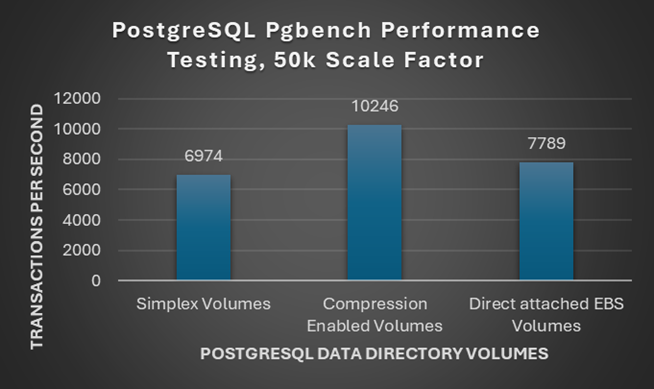
Performance analysis across all workloads and scale factors confirms that VSP One SDS Block on AWS delivers optimal results with compression enabled, outperforming directly attached Amazon EBS volumes. The Data Reduction function also enhances storage efficiency while significantly reducing the physical capacity footprint in comparison to directly attached EBS storage.
At a database scale factor of 10,000, data reduction achieved a 3.65:1 ratio, improving to 3.98:1 at a database scale factor of 50,000. These results demonstrate increased effectiveness of data pattern identification as dataset size grows, yielding greater capacity savings.
Throughout testing, transaction throughput (TPS) remained consistent, indicating minimal performance overhead. This combination of sustained database performance and efficient capacity utilization makes VSP One SDS Block on AWS well-suited for enterprise-scale PostgreSQL deployments.
For more details on the performance comparison between simplex volume, compression-enabled volume, and directly attached EBS volume, please refer to the figures below.
Conclusion
This evaluation demonstrates that VSP One SDS Block on AWS is a high-performing and cost-efficient storage solution for PostgreSQL workloads in the cloud. Compared to traditional simplex and directly attached EBS storage, VSP One SDS Block delivers higher throughput while reducing storage consumption through built-in data reduction function.
As workloads scale, these efficiency gains increase, enabling organizations to lower infrastructure costs without sacrificing performance. Combined with its highly available and resilient architecture, VSP One SDS Block on AWS provides a strong foundation for enterprise PostgreSQL deployments and supports modern, data-driven cloud strategies.
For additional details on the architecture and test results, see the following reference architecture: https://docs.hitachivantara.com/v/u/en-us/virtual-storage-platform-one-sds-cloud/1.18.1/mk-sl-411
#VSPOneSoftwareDefinedStorage