As enterprises modernize their infrastructure to support data-heavy applications, the choice of storage connectivity becomes a key performance factor. Two common options are 64G Fibre Channel (FC) and 25G iSCSI over Ethernet.
Both deliver high-speed connectivity, but their performance differs in throughput, latency, and scalability. This blog compares the two technologies with real-world benchmarks across workloads with VSP One B28 array.
Pros & Cons: 64G FC vs 25G iSCSI
64G Fibre Channel (FC)
Pros:
- High performance: Faster than 25G iSCSI
- Ultra-low latency: Ideal for demanding, time-sensitive workloads
Cons:
- Higher cost: Requires FC HBAs, FC switches, and FC-enabled storage
- Less flexible: Limited to storage traffic; doesn’t converge with LAN
25G iSCSI (Ethernet)
Pros:
- Cost-effective: Leverages standard Ethernet NICs and switches
- Flexible & converged: Storage + LAN traffic can share the same network
Cons:
- Lower performance: Lower performance than 64G FC
- Higher latency: TCP/IP and iSCSI overhead add jitter and delays
Workload Performance Comparison:
This blog evaluates the performance of 64G Fibre Channel (FC) and 25G iSCSI with Hitachi Global Active Device (GAD) enabled across various workloads, including OLTP, VDI Full Clones, VMware Large Block, and VMware Apps, highlighting throughput differences for enterprise storage connectivity.
OLTP
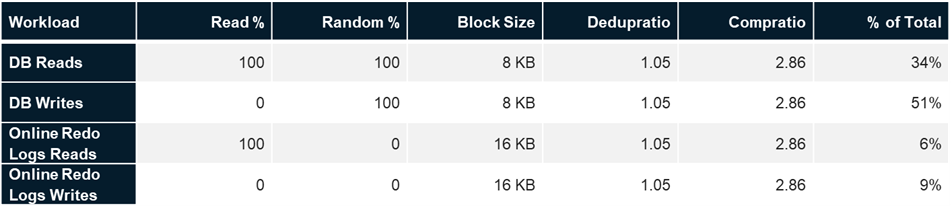
This workload mimics the I/O profile of an Oracle database. It uses four constituent sub-profiles which are run together.
There are two iterations:
OLTP High Hits: 70% read and write cache hit rates
OLTP Low Hits: 30% read and write cache hit rates
Table 1: OLTP workload
Performance Comparison:
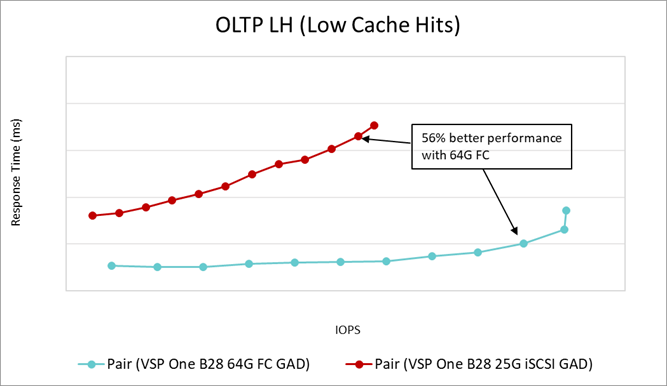
The OLTP HH workload achieved 76% higher throughput, while the OLTP LH workload delivered 56% higher throughput with 64G FC compared to 25G iSCSI.
Figure 1: OLTP High Hits
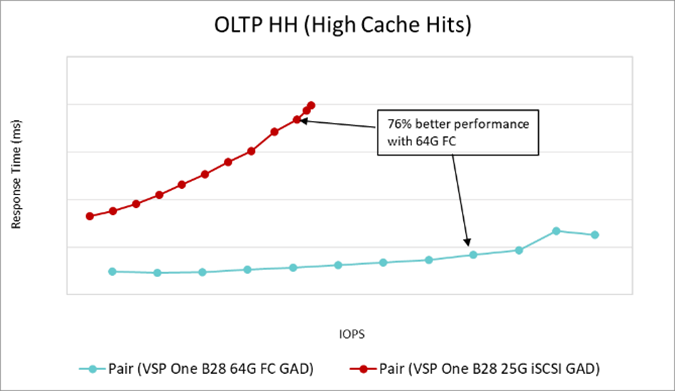
Figure 2: OLTP Low Hits
VDI Full Clones
This workload mimics Virtual Desktop Infrastructure with:
10:1 deduplication ratio.
2:1 compression ratio.
Table 2: VDI workload

Performance Comparison:
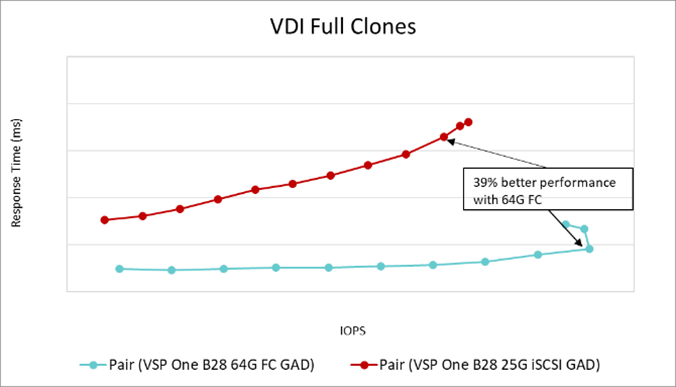
VDI Full Clones achieved 39% higher throughput with 64G FC compared to 25G iSCSI.
Figure 3: VDI Full Clones
VMware Large Block
This workload mimics an aggregated I/O profile of storage system running mostly VMware. It uses two constituent sub-profiles which are ran together.
The following data reduction ratios are used for this workload:
2:1 deduplication ratio.
2:1 compression ratio.
Table 3: VMware Large Block workload

Performance Comparison:
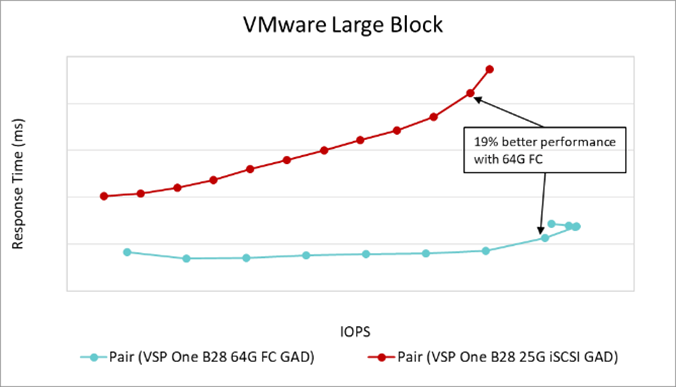
VMware Large Block achieved 19% higher throughput with 64G FC compared to 25G iSCSI.
Figure 4: VMware Large Block
VMware Apps
This workload mimics four common VMware applications. Volumes are provisioned in sets of five: one Exchange, one OLTP, one SQL and two web volumes.
There are two iterations:
VMware Apps High Hits: 70% read and write cache hit rates
VMware Apps Low Hits: 30% read and write cache hit rates
Table 4: VMware Apps workload

Performance Comparison:
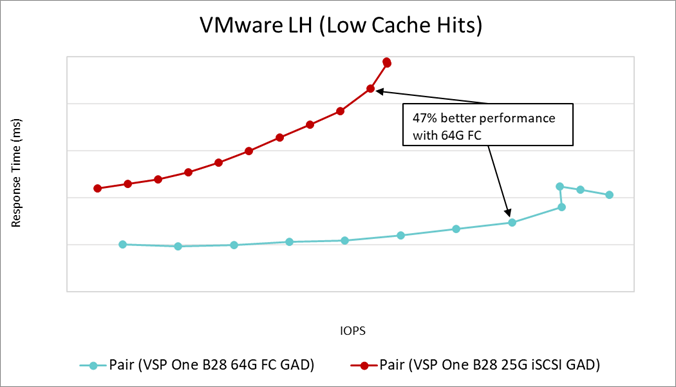
The VMware HH workload achieved 142% higher throughput, while the VMware LH workload delivered 47% higher throughput with 64G FC compared to 25G iSCSI.
Figure 5: VMware High Hits
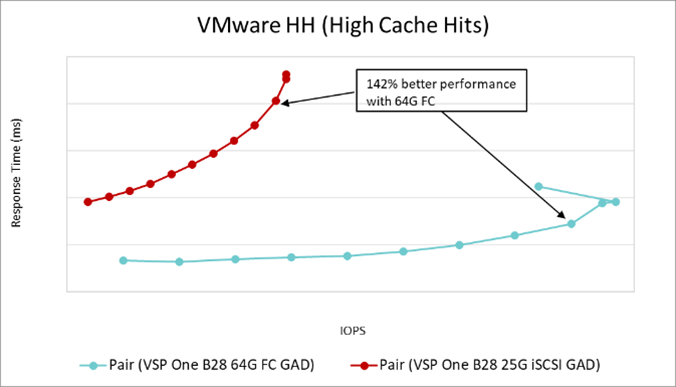
Figure 6: VMware Low Hits
Copy Operations
Performance Comparison:
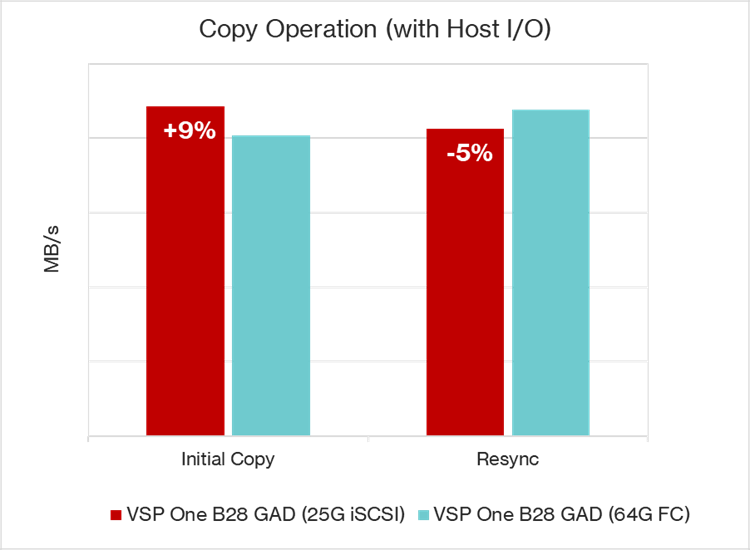
The Hitachi Global Active Device performance data shows 25G iSCSI significantly outperforms 64G FC in initial copy operations throughput. However, resync throughput is impacted in 25G iSCSI.
25G iSCSI delivers 19% better throughput Initial Copy operations, however 11% lower resync throughput compared to 64G FC.
Even under active I/O load, the throughput pattern in both the operation remains similar compared to 64G FC, i.e. 9% higher in Initial copy and 5% lower in Resync.
Figure 7: Copy Operations without Host I/O
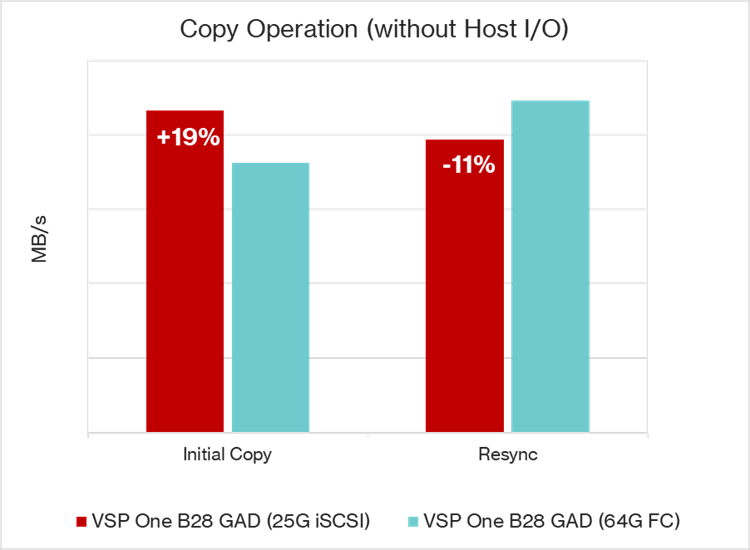
Figure 8: Copy Operations with Host I/O
Test Environment
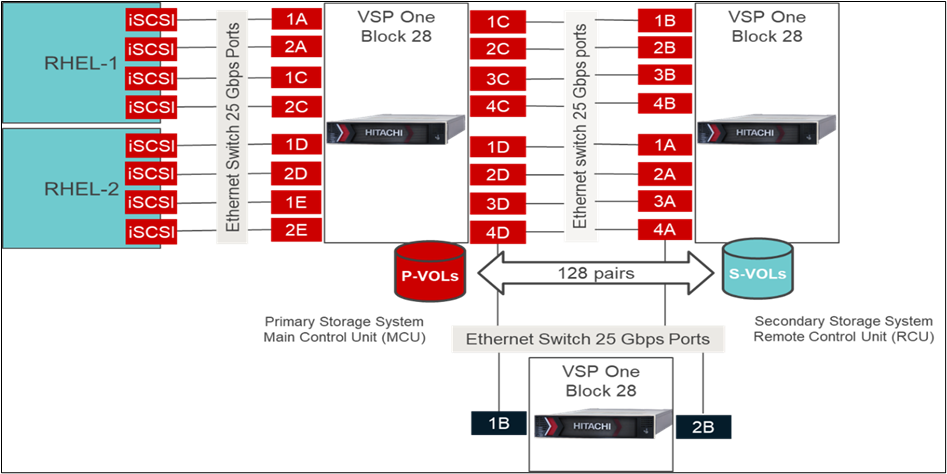
Test Environment 25G iSCSI:
Figure 9: Test Environment with 25G iSCSI
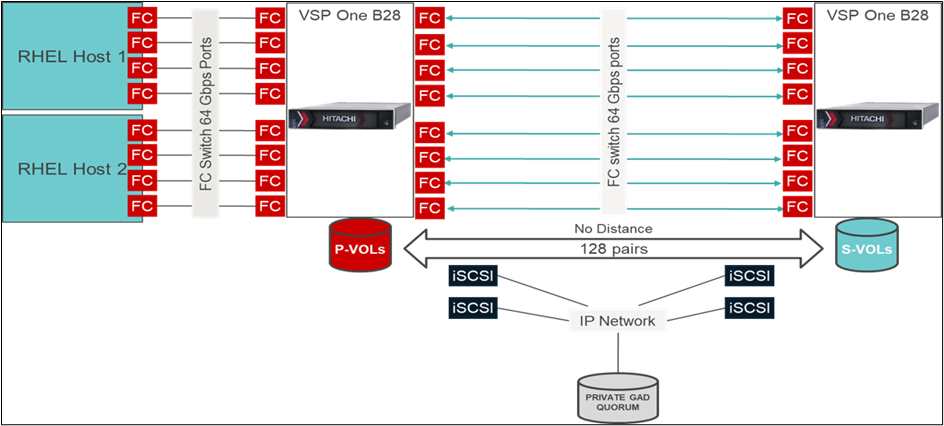
Test Environment 64G FC:
Figure 10: Test Environment with 64G FC
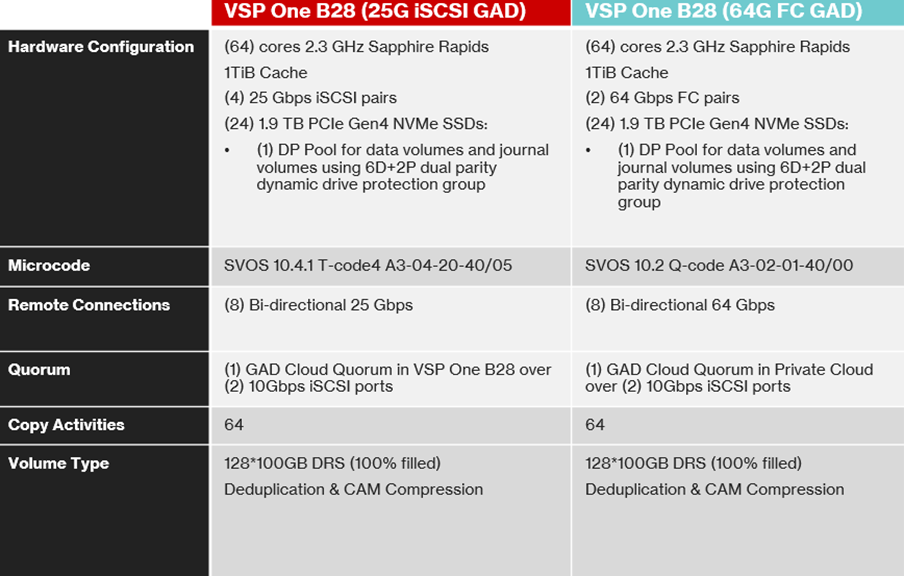
Comparisons: Configuration Details
Table 5: Configuration Comparison details
Conclusion:
64G Fibre Channel delivers 19–142% higher throughput and lower response times across diverse workloads. 64G FC significantly outperforms 25G iSCSI in copy operations throughput.
64G FC is the clear choice for performance, reliability, and mission-critical workloads. While 25G iSCSI is the choice for cost optimization, flexibility, and ease of integration with existing IP networks.
#VSPOneBlock#GlobalActiveDevice