Introduction
As organizations migrate mission-critical PostgreSQL workloads to the cloud, they often encounter a "storage wall" where native cloud disks struggle to maintain the low latency and high consistency required by enterprise OLTP systems. While tuning the database is essential, the true bottleneck frequently lies in the underlying storage subsystem.
This blog explores a high-performance reference architecture that integrates PostgreSQL 16 with Hitachi Virtual Storage Platform (VSP) One SDS Block, demonstrating how software-defined storage (SDS) can outperform native Azure Premium SSD v2 (PV2) in throughput, stability, and total cost of ownership.
The Challenge: Bridging the Cloud Storage Gap
In a standard Azure deployment, PostgreSQL typically relies on Managed Disks. While functional, these disks can exhibit performance variability—swings in Transactions Per Second (TPS) and latency spikes—when subjected to sustained, high-concurrency workloads. For financial systems, order processing, and inventory management, these fluctuations translate to unpredictable user experiences.
Hitachi VSP One SDS addresses these gaps by bringing enterprise-grade data management—historically reserved for on-premises SANs—directly into the Azure environment.
Solution Overview
The architecture designed for this study prioritizes fairness, repeatability, and enterprise relevance. By isolating storage as the only variable, the benchmark quantifies the impact of the storage layer on database health.
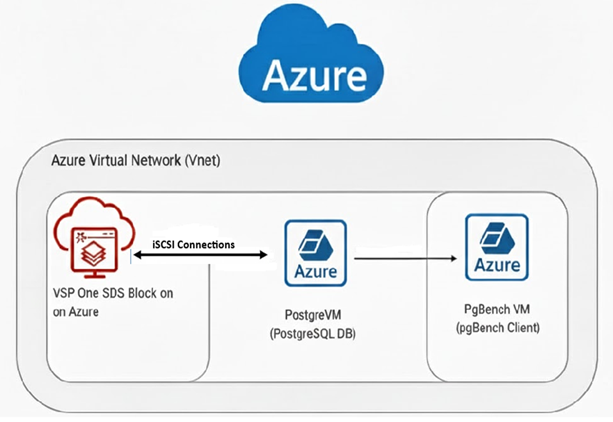
Core Architecture Components:
- Database: PostgreSQL 16 running on Red Hat Enterprise Linux 8.10.
- Compute: Azure Standard D32s v5 (32 vCPUs, 128 GiB RAM) for both the database and the workload generator.
- Storage Backend (Hitachi SDS): A 6-node cluster providing 64 TB of logical capacity via iSCSI.
- Storage Backend (Native Azure): Six 4 TB Azure Premium SSD v2 disks directly attached to the VM.
- Workload: A TPC-B-like profile executed via pgbench with a scale factor of 10,000 and 64 concurrent clients.
The Hitachi SDS Advantage: Engineering Beyond the Disk
While native cloud storage provides basic block volumes, Hitachi VSP One SDS introduces a sophisticated software-defined layer that abstracts the physical cloud resources into an intelligent, high-performance pool.
1. Patented Polyphase Erasure Coding (HPEC)
Unlike traditional RAID or simple mirroring, Hitachi’s patented HPEC is designed specifically for distributed SDS environments. It provides:
· Optimal Performance: HPEC prioritizes local drive access, eliminating network overhead for read operations.
· Write Acceleration: It acknowledges write operations instantly after logging data across nodes, keeping write latency on par with mirroring but with significantly higher efficiency.
· Node-Level Resilience: If an entire Azure VM node fails, HPEC ensures data remains available without manual intervention.
2. Enterprise-Grade Data Efficiency
Hitachi SDS utilizes inline deduplication and compression that operates at the storage controller level. In the PostgreSQL testing environment, this achieved a 3.87:1 data reduction ratio.
· Logical vs. Physical: You can provision 100TB of database capacity while only paying Azure for ~26TB of physical disk space.
· Performance Stability: Because less physical data is written to the underlying Azure infrastructure, the system avoids "throttling" often seen with native cloud disks during heavy I/O bursts.
End-to-End Operational Workflow
The workflow of this solution follows a structured path from workload generation to intelligent data placement:
1. Workload Initiation: The pgbench client VM initiates a mix of transactional requests (INSERT, UPDATE, SELECT), simulating heavy multi-user stress.
2. Processing Layer: The PostgreSQL engine processes these requests. It relies on the OS-level XFS file system, which is striped across the storage volumes to balance I/O throughput.
3. The SDS Data Plane: In the Hitachi configuration, I/O requests travel via iSCSI to the VSP One SDS cluster.
4. Self-Healing & Protection: HPEC stripes data across multiple nodes with parity blocks. If a volume or node fails, the system automatically reconstructs the data in the background, keeping the database online and healthy.
Benchmarking Results: The Data Speaks
The head-to-head comparison yielded a clear winner for enterprise-scale requirements:
|
Metric
|
Hitachi VSP One SDS
|
Azure Premium SSD v2
|
Difference
|
|
Avg. Throughput (TPS)
|
14,215
|
9,199
|
+55% for Hitachi
|
|
Avg. Latency
|
4.5 ms
|
6.95 ms
|
35% lower latency
|
|
Max Latency Spikes
|
< 6 ms
|
> 10.6 ms
|
2x more stable
|
Conclusion: The Strategic Choice
The results of this study are conclusive: for organizations running PostgreSQL at scale on Azure, the storage backend is no longer a "background detail"—it is the most influential factor in achieving predictable performance.
Hitachi VSP One SDS Cloud doesn't just provide more speed; it provides operational and financial confidence through two critical pillars:
- Unmatched Data Efficiency (3.87:1 Ratio): One of the most striking findings was the 3.87:1 data reduction ratio. By utilizing inline deduplication and compression, Hitachi SDS allows you to store nearly four times the logical data per unit of physical Azure footprint.
- Aggressive TCO Optimization: Performance usually comes at a premium, but the economics here are disruptive. By reducing the physical storage required and optimizing I/O paths, the Estimated Monthly Cost (TCO) was slashed by 51.11%—saving over $9,286 per month in our tested configuration.
For the modern enterprise, the choice is clear. If you are seeking to eliminate latency spikes while simultaneously cutting your cloud storage spend in half, Hitachi VSP One SDS is not just the better choice—it is the only strategic choice for PostgreSQL at scale.
#VSPOneSDSBlock